
Physical AI integration · Built in Japan and Thailand
Bridging LLMs andphysical reality.Safely.
Connect your AI to industrial PLCs and robots, test it on real hardware, and deploy it where people work. Our engineers wire factory floors in Japan and Thailand.
01 · The problem
Software AI is ready. The factory floor is not.
Silicon Valley builds capable AI models. Getting them to move a real conveyor or robot arm is where projects stall.
AI engineers don't speak PLC
Models output JSON. The PLCs behind robots and conveyors use ladder logic, talk Modbus or EtherNet/IP, and execute on a fixed scan cycle. Few AI teams have anyone who has programmed one.
Real hardware is slow to reach
Simulators leave a sim-to-real gap. Wiring 24 V sensors and debugging PLCs in a San Francisco office is slow, expensive and far from a software team's core work.
2D vision misjudges depth
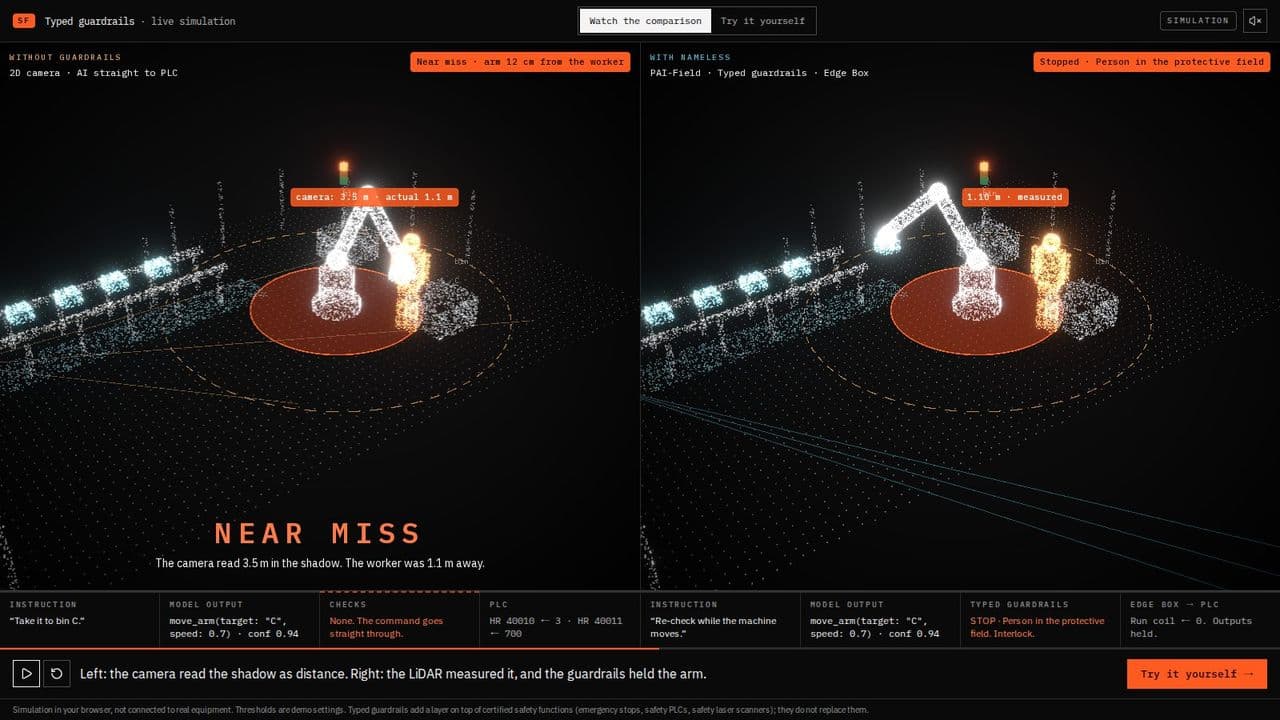
Shadows, glare and dust throw off a camera's distance estimate. Next to a moving machine, one wrong guess is a collision.
02 · The platform
Start with the piece you're missing.
Three entry points. PAI-Ground is open today, Edge Box is being built with design partners, and PAI-Field is in development.
01
Design partners
Nameless Edge Box
Turn a PLC into a REST API.
A box on the same network as your PLC. Your code sends named, typed values over REST or WebSocket; Edge Box checks each one and writes the registers in the PLC's own protocol. No ladder logic on your side.
POST /plc/line-3/conveyor
{ "speed_mm_s": 120, "dir": "fwd" }
How Edge Box works
02
Available now
PAI-Ground
Test on real hardware without owning it.
Run your model against real robots, PLCs and conveyors in our lab in Japan. You get live video, point clouds and PLC logs; our engineers handle wiring and on-site debugging.
pai-ground.namelessjp.com03
In development
PAI-Field
Measured distance for every AI command.
Low-cost industrial 3D LiDAR measures how close people are to each machine, ten times a second. Typed guardrails check every AI command against that measurement and the model's confidence; if either check fails, the interlock stops the machine.
How PAI-Field works03 · Architecture
From perception to execution.
Combined, the three pieces sit between the AI model and the machine, and nothing reaches the PLC unchecked.
Perceive
PAI-Field
3D LiDAR point cloud. Measured distance, not estimated depth.
Decide
Typed guardrails
AI intent becomes typed, confidence-scored actions. Low confidence triggers the interlock.
Execute
Nameless Edge Box
Validated commands go to the PLC over Modbus TCP first, with native protocols to follow. If Edge Box goes quiet, the PLC stops every output Edge Box can command.
Industrial PLCs and robot controllers
Physical world — people, shadows, moving parts
Test your model against real robots and PLCs in PAI-Ground before it touches your floor.
04 · How we work
Design in SF. Execute in Asia.
AI that controls machines only works after someone has stood next to the machine. That is Forward Deployed Engineering, and it is what our teams in Japan and Thailand already do for manufacturers.
Your team designs the model during the Bay Area workday. While California sleeps, it is working hours in Asia: our engineers wire the I/O and run the tests in PAI-Ground.
Our bar is Palantir-grade FDE, not the local contract-development market. We use AI at the same intensity as the teams here, and we measure it every day.
Japan
namelessjp.comThailand
namelessth.comSan Francisco
Serving Bay Area AI and robotics teams
30B+
tokens / engineer / month
About USD 20,000 a month at API prices, per engineer
Daily
measured
Tokens, working time and commits on our own dashboard
8
AI agents in daily use
Our own accounting, ops, meetings, code review and coding run on them
2 × DGX Spark
our own GPUs
Plus three physical servers. Local LLMs and robot simulation in-house
Figures as of November 2026, from our own usage logs.
Mission
Zero Accidents.
We want a physical world where people and autonomous machines work side by side without fear. Automation should protect the people on the factory floor, not just replace them.
Ready to move real machines?
Bring us your model. We'll connect it to your machine, or to ours in PAI-Ground if you don't have one. Tell us what you're building. Investors, we'd like to hear from you too.
Three lines are enough:
- 1 Your machines (robot, PLC make and model)
- 2 What the AI should do on them
- 3 Where and when you want to try it
Or write to us directly: [email protected]